Welcome to FleshlyX
This website is showing adult contents and is strictly prohibited for persons under 18 years old. We decline any responsibility in case of abuse.
This website is showing adult contents and is strictly prohibited for persons under 18 years old. We decline any responsibility in case of abuse.
For years, Craigslist Personals was one of the internet’s simplest ways to meet someone. A short ad, a location, and a reply by email were often all it took to start a conversation. Then, in March 2018, the familiar Personals categories disappeared from the U.S. site almost overnight. The decision marked the end of an online era—and helped reshape the market for personal ads and adult classifieds.
The main Craigslist homepage remains active for housing, jobs, goods, services, and community discussions. It is the old U.S. Personals section—not Craigslist as a whole—that disappeared.
Long before swipe-based dating apps became part of everyday life, Craigslist offered a decidedly low-tech alternative. People could post in categories for romance, casual encounters, and strictly platonic connections. There were no elaborate profiles to build, no endless feed to scroll, and no algorithm deciding whom a user should see.
Its biggest appeal was directness. Listings were organized by city, so people could look for connections close to home. The service also reflected the wider Craigslist culture: plain pages, simple search tools, and a strong emphasis on user-posted content rather than polished presentation.
That freedom came with limitations. Anonymous ads could be misleading, moderation was imperfect, and users had to make their own judgments about trust and personal safety. Still, for many people, Personals filled a niche that mainstream dating services did not.
On March 22–23, 2018, Craigslist took its U.S. Personals section offline after Congress passed legislation commonly referred to as FOSTA-SESTA. The legislation aimed to make it easier to hold online platforms accountable for knowingly facilitating sex trafficking. Craigslist said the prospect of legal liability arising from unlawful use of personal ads created a risk to its broader business.
Importantly, the shutdown happened as Congress passed the bill, before it was signed into law the following month. It was a precautionary decision by Craigslist, not the result of a court ordering the company to remove every personal ad.
The change affected more than the casual-encounters category. Dating and platonic personal listings were removed too. Craigslist itself continued operating for housing, jobs, items for sale, community discussions, and other classifieds, but the original Personals section did not return.
The policy change highlighted a difficult tension in the early era of online communities: open posting made it easy for ordinary people to connect, but also made it difficult to distinguish legitimate messages from abuse. Craigslist chose to remove a broad category of listings rather than attempt to evaluate every post under a changing legal framework.
The effects were felt well beyond people seeking dates. The old Personals area had included strictly platonic ads and several categories for people searching for relationships or companionship. When it vanished, users with very different intentions had to look for new communities, often on websites designed for narrower audiences.
Lawmakers who supported FOSTA-SESTA viewed the legislation as a way to strengthen accountability for online facilitation of sex trafficking. Critics warned that fear of liability could lead to over-removal of lawful speech and push vulnerable users toward less visible channels. The debate continues to shape how online platforms think about moderation and risk.
There was no single replacement. Instead, people moved to a patchwork of services that each preserved a different part of the old experience. Some gravitated toward personal-ad communities that still allowed text-first posts. Others used dating apps that emphasized profiles, photos, and messaging. Users interested in adult listings explored specialized classifieds and directories.
These categories are not interchangeable. A dating app designed for relationships, a community board for platonic connections, and an adult provider directory serve different purposes. The disappearance of Craigslist Personals did not create one new market so much as accelerate a split into several more specialized ones.
Modern alternatives generally take one of three approaches. Text-oriented personals platforms aim to recreate the simplicity of posting an ad and receiving replies. Mainstream dating services place more weight on user profiles, matching, and mobile-first messaging. Adult classifieds and directories focus on location-based listings, provider information, and, in some cases, reviews or verification features.
That last category includes names such as SkipTheGames, ListCrawler, Tryst, and Slixa. Their designs and features differ considerably: some resemble traditional classified-ad boards, while others emphasize detailed profiles and directory-style browsing. Neither format automatically guarantees that a listing is authentic or safe.
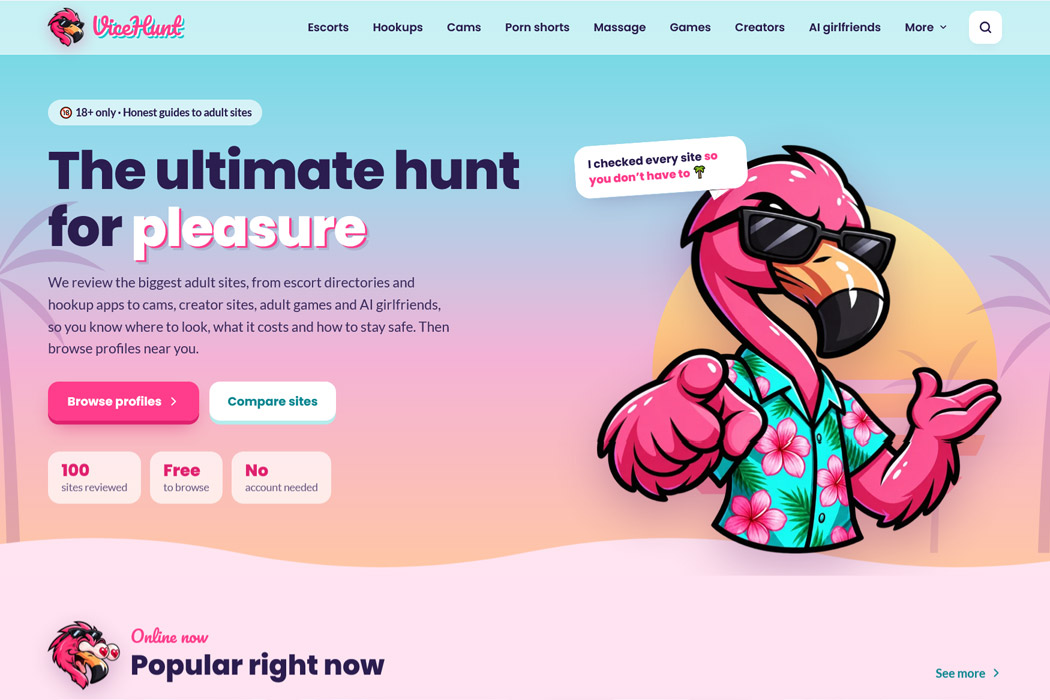
For readers researching that part of the landscape, ViceHunt provides reviews and comparisons of adult listing websites, helping visitors understand the differences between platforms before deciding which ones to explore.
Unlike the mostly text-first Craigslist experience, many contemporary platforms rely on rich profiles, photographs, filters, account systems, and sometimes paid promotion. These features can make browsing more efficient, but they also create new questions about identity, data collection, and how prominently advertisements are displayed.
Dating apps generally favor matching and messaging within an account-based system. Personal-ad communities are more likely to retain the original classifieds model of publishing a message and waiting for responses. Adult directories serve a different purpose again, often organizing third-party advertisements or professional profiles by city. A visitor should identify the category of service before assuming it is a direct substitute for Craigslist Personals.
There is also a trade-off between convenience and openness. Highly curated sites may provide more consistent presentation but require registration or have strict posting rules. Simpler classified-style sites can be easier to explore, while leaving users with more responsibility for assessing claims and protecting their privacy.
The biggest shift has been from a single, catch-all classifieds section toward a fragmented ecosystem. That brings a wider choice of interfaces and specialized features, but also makes it harder to compare services at a glance. A platform with a large audience in one city may have limited activity in another, and terminology such as “verified” can mean different things on different websites.
Costs also vary. Some sites allow basic browsing without payment, while others charge for posting, premium visibility, or additional features. Understanding exactly what a platform offers—and what its moderation does not promise—is more important than relying on a recognizable brand name.
Before signing up or responding to a listing, consider the platform’s purpose and location coverage. Read its rules, privacy policy, and available reporting tools. Look carefully at whether identity or photo verification is optional, what it checks, and whether independent reviews exist.
Treat unexpected requests for deposits, gift cards, cryptocurrency payments, or sensitive personal information as warning signs. Be skeptical of copied photos, inconsistent details, and anyone pushing conversations away from a platform immediately. Follow local laws, and remember that an online listing is not proof of someone’s identity or intentions.
First, check whether a platform actually serves your local area. A busy homepage is not evidence of useful activity in every city. Browse the relevant regional section, look for signs of recently updated listings, and consider whether the advertised category matches the kind of connection you are seeking.
Next, inspect the site’s moderation, reporting, and privacy policies. Transparent rules and clear reporting methods are helpful indicators, although they cannot guarantee the truthfulness of individual posts. Be especially cautious about sites that request sensitive information before explaining what they do with it.
Finally, remember that popularity and reliability are not the same thing. An established name may offer extensive coverage but still attract spam or impersonation. Comparing independent descriptions of how services work is more useful than relying exclusively on advertising claims.
Craigslist initially expressed hope that it might restore the section someday, but as of October 2026 its former U.S. Personals service has not returned. The platform’s continued success in other kinds of classifieds shows that removing Personals did not mean the end of Craigslist itself.
What has endured is the appeal of local, straightforward online connections. Whether users now turn to personal-ad communities, dating apps, or specialized directories, the basic demand that made Craigslist Personals popular remains. The difference is that people must navigate a much broader—and more varied—set of options than they did before 2018.


Wanna know where the ladies are flocking? Get your escort picks according to...
We humans have quite a complex sexuality and mind that can generate unexpected...

In a world of flashing neon, endless categories, and content overload, one brand...

Picking the right device can make a big difference when you want to...